
|


Please read and understand these instructions.
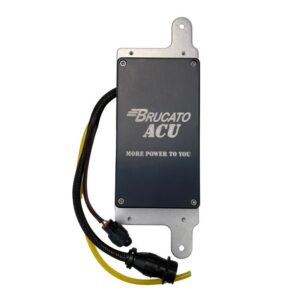
The PCU comes preprogrammed with a preliminary fuel curve for
your application. Contact Brucato, Inc. with any questions you may have at
919-718-0249.
The preliminary fuel curve may be adjusted by the user with
the array of potentiometers contained in the PCU.
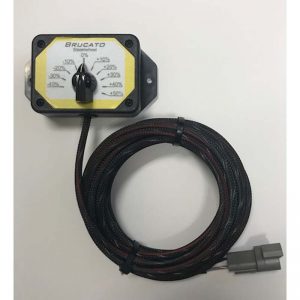
The overall fuel delivery may be adjusted with the optional
steamwheel.
Acceleration Compensation feature adds extra fuel delivery
when throttle movement is detected for optimum acceleration.
The programmed fuel curve may be customized with the optional
interface cable. This allows manipulation of fuel delivery at different
vacuum/RPM levels. Additionally, the rev limiter can be adjusted.
With the optional extension harness, the PCU can be mounted
next to the driver for easy adjustment.
INSTALLATION INSTRUCTIONS
Connect ECU harness, vacuum line, and steamwheel (if used) to
the PCU.
Mount the PCU, securely in the cockpit within reach of the
driver utilizing the extension harness. This allows for easy adjustment and
will extend the life of your PCU by avoiding engine heat and vibration.
IT'S THAT SIMPLE!
TUNING YOUR PCU
Tools Needed:
Small Phillips screwdriver
Exhaust gas pyrometer — recommended
KNOB ADJUSTMENT SETTINGS
After removing the cover of the PCU, you will see several
knobs which have an adjustment range of -15% counterclockwise and +15%
clockwise.
The pointer location of the Phillips head is denoted by the
slot with half circles on either side. (Shown straight up in the first
image below ñ 0%).
Each of the graduations on the body of the potentiometer
represents approximately 4% adjustment, however, adjustments as small as 1%
may be made. Negative adjustments are counterclockwise and positive
adjustments are clockwise, as shown below.

FUNCTIONS DESCRIPTION
Knob marked "Main"
controls entire fuel delivery.
Accel Comp
Sensitivity adjusts the minimum amount of throttle movement
required to activate Accel Comp function.
Accel Comp Volume
controls volume of extra fuel metered during acceleration.
Part Throttle – adjusts
fuel delivery +/-15% at less than full throttle in the RPM range of 1,800
through 7,500 with no affect at wide open throttle.
Idle
- adjusts fuel delivery +/- 15% at less than full throttle in the RPM rage
of 0 through 1,800 with no affect at wide open throttle.
Group 2 and Group 3
Injectors are grouped in pairs. Group 1 controls cylinders 1
and 2, Group 2 controls cylinders 3 and 4, and Group 3 controls cylinders 5
and 6. Groups 2 and 3 can be adjusted separately from the Main adjustments
+/-15%.
RPM Knobs
The programmed fuel curve can be altered at the various RPM
levels +/-15%.

Tuning Your PCU
Although it is
simple to tune the PCU, thorough knowledge of engine tuning and the means
to monitor the fuel mixture of your engine will be required. If you are
unsure of your ability to tune the PCU, contact a professional for
assistance.
A previous benchmark exhaust temperature reading from your
engine at each RPM band will be very helpful to you when tuning the PCU.
Tuning of the PCU is meant to begin on the rich side of the
fuel curve, and then carefully worked back to the optimum fuel mixture.
After mounting and connecting your PCU and steamwheel, with
boat and motor in the water, start and idle the engine. Set the steamwheel
at +10% while watching the pyrometer, run the boat up to full throttle,
making note of any RPM range that brings the pyrometer reading up to
normal.
In increments of 4% or less, adjust the steamwheel lean,
repeating the above instructions until some of the RPM band are at the
correct fuel mixture. At this point, you will have identified which RPM
bands need adjustment.
The fuel curve can be adjusted precisely by using the knobs,
either adjusting rich or lean as needed at specific RPM points.
EXAMPLE: The exhaust gas temperature approaches optimum
reading only in the 5,000 to 6,000 RPM range, and the rest of the RPM range
appears rich. The method for tuning is to add additional fuel in the 5,000
to 6,000 RPM range via the knob adjustments, and then remove fuel overall
with either the Main adjustment knob or steamwheel. Continue this method
using smaller values until a satisfactory fuel curve is achieved.
At this time, you will have a 95% finished fuel curve.
Further tuning will involve concentrating on smaller adjustment increments
on certain RPM ranges, at wide-open throttle, utilizing the methods
previously discussed.
NOTE: Turning the steamwheel knob fully counter clockwise
through the negative range will reset the adjustment to 0%.
NOTE: To load the engine down at various RPM levels long
enough to get sufficient data for adjustment, it may be necessary to use a
large pitch propeller and negative trim.
Acceleration Comp — It may be necessary to experiment with
different settings of volume and sensitivity to achieve crisp acceleration
from idle.
Group 2 and Group 3 Adjustments — After tuning the fuel curve
as we did above, plug readings should be taken to determine if any group of
injectors requires fuel compensation.
Brucato
Pro Control Unit | Brucato PCU
Features | PCU Management Software
| Facts | PCU
Instructions | Pricing | Home
Page
|